1970 – 1979
A Sunrise Industry Emerges
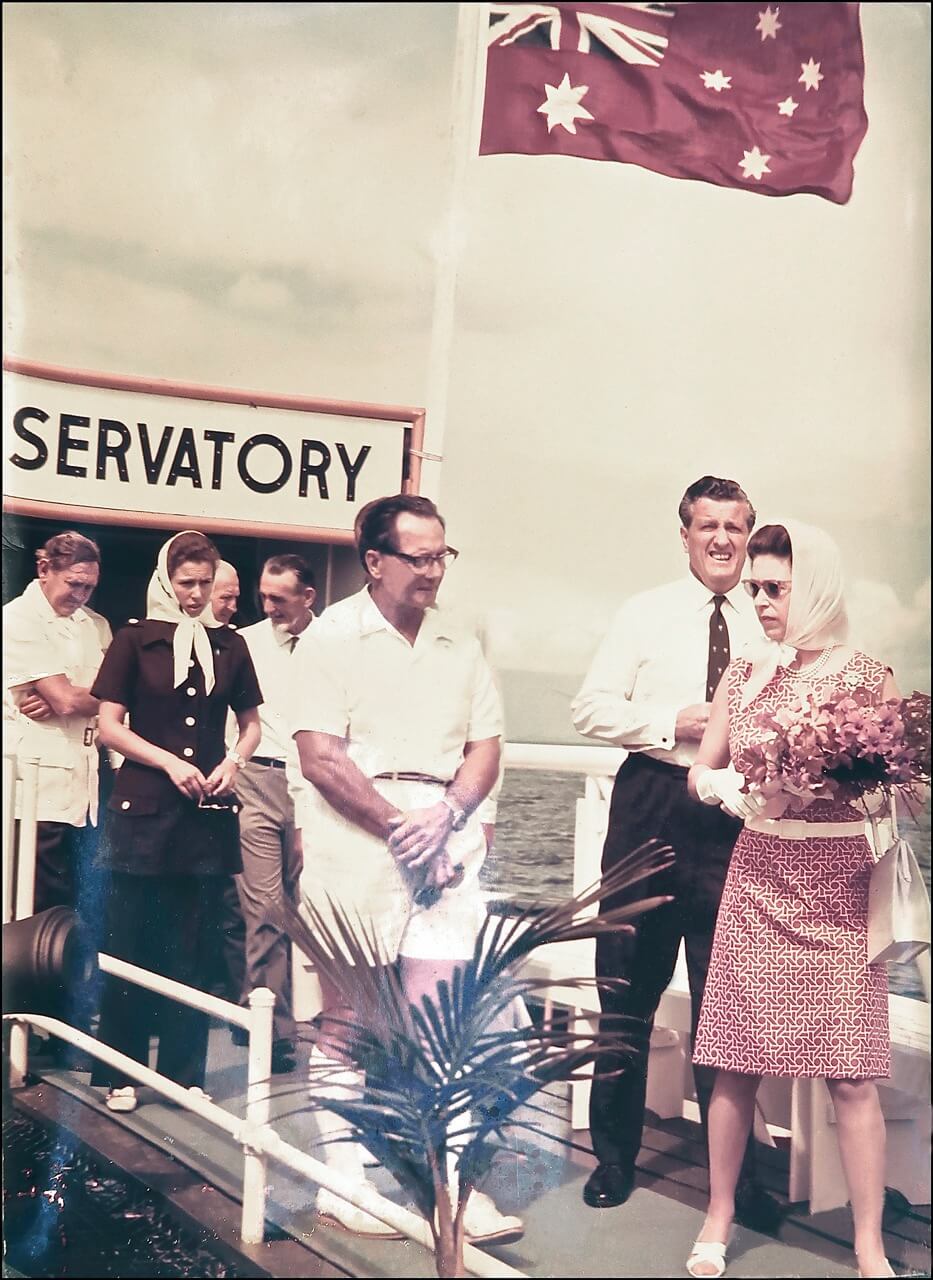
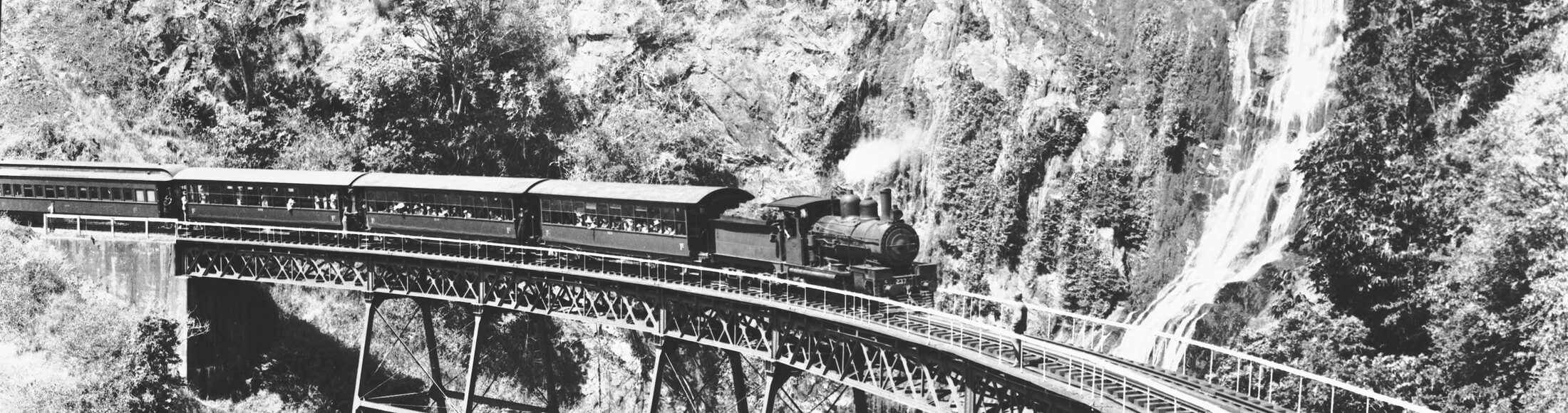
While the world was experiencing the cultural, social and political shifts of the dynamic 1970s unfold, the 30,000 people living in Cairns were starting to take note of a sunrise industry in their midst – tourism. In the early 1970s Queensland roads were improving bringing Australians further north and aircraft travel was increasing with international stars like Lee Marvin arriving in Cairns in search of the legendary black marlin. The Kuranda train had been winding its way through the spectacular Barron Gorge since 1891, and in 1924 a commercial tourism operation was established with Hayles boats taking day trippers to Green Island. In 1954 Vince Vlassoff and Lloyd Grigg developed a world-first, Green Island’s famous Underwater Observatory.
Industry leaders such as Ben Hayles had emerged in the 1960s with the reef operator becoming president of the Cairns and District Travel League, one of the first tourism organisations created in the region. However, most of the region’s business entrepreneurs were from other industries and were associated with the Cairns Chamber of Commerce, including surveyor George Chapman who was among the founding members of the Cairns Regional Development Bureau, established to attract investment in the region. Its first meeting, held on 5 April 1967 and chaired by Alderman Vince Donnelly, drew 27 keen observers.
A Tourism Committee was set up that year chaired by J. Golightly. Chapman recalls the hard work to raise $5000 which was only enough to set up the office with a secretary, meaning they had to wait another year before they could appoint a manager, Thomas Baty.
In 1970 the organisation was renamed the Far North Queensland Development Bureau, with a new constitution to appoint directors representing the geographical, economic and communal aspects of the region. Not long after, the potential of tourism was outlined in the Great Barrier Reef Visitor Plan, a report delivered by American consultants in April 1971, which came up with the concept of the Great Boomerang for international tourism growth. It recommended Sydney, the Red Centre and the Great Barrier Reef be marketed to Americans, who were driving the growth of international visitation to Australia.
In April 1971 the Board discussed making a bid to become responsible for regional tourism believing regional development and tourism should come under the one administration by the Bureau. However, the Bureau needed to show it had the finance through membership for this to be accepted.
A public meeting in May resolved to form a finance committee to secure funds and the mayor invited the city’s tourism enterprise proprietors to a June meeting to consider a room tax on hotels and motels as an alternative to a subscription. The Bureau anticipated the tax proposal would be rejected and decided to approach the Cairns and District Travel League President Arthur Strike about joint promotion of tourism in the region. The idea of a sub-committee of the Bureau to promote tourism was raised before another public meeting was held discussing a possible merger between the League and the Cairns and District Tourism Association. It was resolved that these two organisations and the Bureau draft a prospectus for an FNQ tourist authority.
While this debate was unfolding, the Australian National Travel Association (ANTA) released the North Queensland Tourism Study in April 1971, after sending a team the previous year to assess the tourism potential of the area from Bowen to Cairns. The study recommended establishing the North Queensland Travel Council with development bureaus in Townsville, Ingham and Cairns. In August 1971, the Bureau elected to become a member of ANTA.
Marketing Becomes Professional
In October 1971 the Development Bureau resolved to establish a sub-board for tourism and then launched Operation Investment, a major fundraising drive by professional fundraisers Compton Associates, which sought pledges from businesses and local government across the region to establish a five-year tourism promotion program.
The inaugural meeting of the Far North Queensland Board for Tourism and Travel was held shortly after on 23 November 1971. Cummings credited much of the board’s formation to Johnstone Shire Chairman Roy Dickson who was President and Chairman of the Development Bureau at the time. The fledgling tourism sub-board was chaired by Cairns Mayor David Thomas de Jarlais with Mr T. Walker, Chairman of the Cairns/Mulgrave Advisory Committee appointed as Vice-Chairman. Other members included councillors from the Shires of Mareeba, Eacham, Atherton, Herberton, Johnstone, Mulgrave and Douglas.
Operation Investment was officially underway in 1972 and was overseen by a committee of community business leaders chaired by Carlton United Brewery Manager Peter Forness. The target to raise $200,000 over five years – the equivalent of $2.8 million today – was successful.
Also in 1972, the North Queensland Travel Council was created with Cummings, who was managing the Ingham Research and Promotion Bureau, serving as secretary, and Bush Pilots Chairman Sir Sydney Williams, the Chairman. While planning the first consumer travel promotion in 1972, Cummings approached local printer Bob Bolton, whose colour photography had been widely used in tourism brochures. Bolton’s photos were incorporated into a cutting edge visual and audio presentation, which was later adapted for trade audiences. The Travel Council gradually faded when Cummings was appointed Manager of the Development Bureau in 1973. It was eventually abandoned in 1975.
New Kid on the Block
The FNQ Board for Tourism and Travel gained momentum following the appointment of Irishman Sean O’Hagen as Tourist Promotion Officer in May 1972. Having previously promoted tourism in New Zealand, O’Hagen brought valuable experience to the role. Under his tenure, information centres were established in Cairns and later in Mourilyan, and development began on the Australian Sugar Industry Museum.
A regional Tropic Wonderland film was produced in association with TAA, supported by promotional brochures describing the region as “warm, green and friendly”, and annual visitor guides were published. Relationships were developed with the Australian Tourism Commission (ATC) and the Queensland Government Tourism Bureau to host visiting agents and journalists on familiarisations (famils). The region also moved quickly to organise promotion teams for regular industry travel shows like ANTA, Talkabout and Destination Australia.
The Gold Coast had long dominated destination marketing in Queensland, but the Far North was beginning to make its presence felt with strong industry support. “We were the new kid on the block,” said Cummings. “Our first promotions in 1973 were supported by the airlines who flew our industry team south to promote the destination. We wore white safari suits as a uniform. To create a broader team, Sean and I were joined by industry including Ben Hayles, Bush Pilots senior air hostess Pam Wattling, and Percy Trezise who was promoting the Quinkan rock art galleries.”
Trezise had recently uncovered the extent of the now-famous galleries near Laura and was actively advocating for their protection. He also helped establish the Indigenous Laura Rangers. Cummings hoped Trezise’s unique story and cultural advocacy would help attract media interest.
The Board’s quest for media attention was achieved the following year when Gary Zillfleisch from Hartley’s Creek Zoo took a 1.5m crocodile to shopping centre promotions in Canberra, Melbourne and Sydney. Cummings said his carefully prepared projector visuals were immediately upstaged as soon as the croc appeared. “I can remember being in a hire car with Gary and the croc was lying across the back seat behind me. We took it into a newspaper office in Melbourne and the staff insisted on putting it in the editor’s office facing the door with journos bowling into the room and being confronted by a croc.”
By the following year tourism was gaining recognition as a new industry throughout the country with the Department of Tourism and Recreation stating in 1975 that tourism was an important ingredient in the development of region areas that would create new job opportunities and provide an alternative source of foreign exchange earnings.
Getting Down to Business
A fully fledged tourism promotion bureau emerged in the mid-70s after a series of changes to the organisation and its name. Modern day records show the Far North Queensland Promotion Bureau Limited was registered under the Corporations Act on 12 September 1975 as a non-profit company limited by guarantee, but this name did not come into use until 1978, as reflected in the FNQ Development Bureau minutes from 1975 to 1978.
The subscribers to the Memorandum of Association were George Chapman, civil engineer Alan McPherson, former Mayor David de Jarlais, Peter’s Ice Cream manager Keith Geary, surveyor Donald Michael, mechanical engineer Don Fry and pharmacist Peter Cominos. This change is celebrated as the birth of the first professional destination promotion organisation for the Far North. It is arguably the first Regional Tourism Organisation in Australia and preceded the State Tourism Organisation by four years.
At this time, the Board for Tourism and Travel was still operating with its Chairman Tony Mijo, who also served as the Douglas Shire Council Chairman. He was later succeeded by Gordon McKauge, a local businessman who had established a new coral jewellery manufacturing enterprise. Around the same time, Kim McDowell, who had been working for the Federal Tourism Minister, became the Tourism Promotion Officer.
The region was starting to be noticed by the film industry with Francis Ford Coppola and his production team scouting locations for Apocalypse Now. Cummings and rainforest tour operator Colonel Sam Davis spent a lot of time driving the Hollywood legend around in the hope it would bring publicity the destination could not afford to buy as well as a $4 million immediate injection into the community during filming. “They had been to the Philippines, and all got tummy bugs before they arrived here to discover that we had the jungle and buildings like the old tropical theatre that they could use for sets and as a base. They needed a lot of helicopters, so I went to Canberra to try to organise them, but the Australian Army was not keen. In fact, the soon-to-be Defence Minister Jim Killen told me not to waste my time. Mrs Marcos was able to organise military helicopters in the Philippines, so we lost it to them.”
Publicity was the name of the destination marketing game and in 1976 adverse publicity started to irk the tourism sub-board. The Directors were concerned about the media’s reporting of cyclones, incorrect reports of Cairns being booked out, stories about airfares to international holiday destinations being cheaper than Cairns, and the issue of penalty rates for catering over the June long weekend.
By 1977 the Cairns population had grown to 48,000 and the Far North’s to 127,000. Unemployment was becoming an issue across the nation with inflation at 10%. However, Queensland was faring a little better as the abolition of death duties in the state had enticed investment and there was a “considerable increase” in new accommodation built. Cairns has seen growth in motels, flats and caravan parks, but the increase in room stock combined with the depressed economy and prolonged wet led to occupancy falling 1.2% between the second half of 1975 and 1976.
The Far North still held its own compared with other Australian destinations with Bureau of Statistics figures showing the number of room nights increased by 5.3% in the second half of 1976 compared to the previous year, whereas Queensland showed no growth and there was a decline in the Australian total.
Air travellers were staying for 7-22 days, coach 2-5 days, and car 1-4 weeks with peaks during the school holidays and most arriving by car. Caravan parks and self-contained holiday flats were the most popular with motels too expensive for the average tourist. Four-wheel drive tours had started taking visitors to more remote parts of FNQ and an expanded range of cheaper airline packages and coach tours was being promoted in major southern markets that year.
TAA and Ansett provided free air travel for the Board to undertake two southern promotion trips – five weeks in duration in 1976 and four weeks in 1977. During the second promotion the Board attended Talkabout, a trade show organised by ANTA, with Bush Pilots Airways, Hinchinbrook Island Resort and Tracks Tours. A Visitor Guide to the Top of the Sunshine State was printed in 1977-78 with 20,000 copies distributed, mostly through Queensland Government Tourist Bureau offices in the south.
The Board’s responsibilities in 1977-78 included looking after the Visitor Information Centres in Cairns and Mourilyan, operating an after-hours accommodation service, welcoming 14 cruise ships with visitor information, and hosting famils. A Courtesy Campaign was launched in the media seeking community cooperation in being courteous to visitors and enabling frontline staff to be helpful.
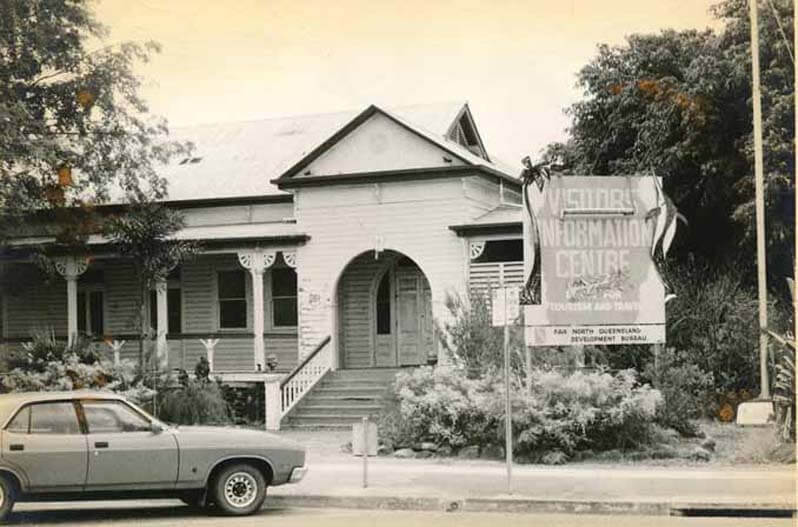
Charlie Woodward, who had opened Mountain Groves in Kuranda and founded Tropic Wings in 1976 with his wife Pip, chaired the Visitor Information Committee overseeing the development of a new visitor information centre in Cairns at the former Fire Brigade building in Lake St.
Industry advocacy included a submission to the Select Committee on Tourism, successfully lobbying the Weather Bureau to change some aspects of its reporting of cyclones which had been detrimental to tourism, pressure on the Bureau of Statistics to continue quarterly accommodation surveys and extend them to caravan parks and holiday flats, and lobbying for assistance to control erosion at Green Island.
In March 1978, professional fundraisers Compton Associates reported on the apathy encountered at combined Board meetings to discuss further fundraising for the Bureau. The Bureau needed to raise $1 million over five years. However, the Board later decided to do away with professional fundraising and implement membership. The FNQ Ambassador Club was formed on 27 June 1978 with Helen Hogan as Chairman to bring together the Bureau’s subscribers in a social atmosphere with the first event at Hides Hotel.
In May 1978 the Board agreed the two separate names of the Board and sub-board be discontinued, and the name Far North Queensland Promotion Bureau Ltd be adopted. The last meeting of the Far North Queensland Development Bureau Limited Board was 26 July 1978 with the name changed for the next meeting in August. The Bureau Board was expanded to include additional members from the tourism industry.
Among the staff to work at the Bureau in its early years was Jill Hynes, who initially stepped in to assist in 1979 while Cumming’s administration officer was on leave. Hynes and her husband Ted had purchased The Reef House in 1975 from Brigadier David Thomson who had gone on to become the Member for Leichhardt. Hyne’s tourism expertise quickly proved invaluable, and she remained with the Bureau as Tourism Industry Liaison Officer, representing the organisation at trade shows including Talkabout and the Australian Tourism Exchange. When the couple sold The Reef House in 1981, they went on to establish the first inbound tour operator north of Brisbane, Inbound North Australia. Jill also started the local branch of PATA becoming the North Queensland representative.
Time for New Markets
Chapman wrote in the Annual Report for the year ending 31 May 1979 that the region was performing well with significant growth in airline package tours and the latest Australian Bureau of Statistics figures showing the Far North was the major growth area for the State. The opening of new air routes via Port Moresby to Honolulu and Singapore had seen an upsurge in international visitors.
A fundraising campaign brought a 50% increase in business contributions allowing the Bureau to undertake three domestic tourist promotion activities including a summer discount program. The Bureau led a 17-person promotion mission to Darwin and Gove in December 1978 and smaller missions to Hobart, Launceston, Melbourne, Canberra, Sydney and Brisbane in February. During these years, the Bureau also launched a promotion mission to Alice Springs to support the vital airlink to Cairns and sent a promotion team including the Sandy and Sunshine green crocodile costumes used at the annual Fun in the Sun parade through a number of centres in country Queensland.
Domestic air passenger numbers had risen almost four-fold over the 10 years to 1979, surpassing those through Townsville. By then, Cairns had also become the international gateway for services to Papua New Guinea and Irian Jaya. However, when the Parliamentary Select Committee report was released in late 1979, it made the surprising recommendation that Townville, not Cairns, be upgraded as the main international gateway in the North-East. In response, the Bureau dedicated much of the next two years to working with community organisations to advocate for an upgrade of Cairns Airport to accommodate wide-bodied aircraft for long distance international flights.
Although the Commonwealth Government indicated Cairns ranked low in funding priority, it did highlight a scheme to transfer ownership of regional airports to local communities. A public meeting was convened, where Chapman, Mayor Ron Davis, Cairns Harbour Board Chairman Mick Borzi and four others formed the Cairns Airport Development Committee. Their first meeting was held on 20 February 1979 to investigate feasibility of local ownership.
Cairns’ case for an international airport was strengthened when the city hosted the first Japanese tour groups. Air Niugini, which had developed services to Kagoshima and then Fukuoka in Japan, asked the Bureau if they would host a series of Japanese tour groups each week. The Bureau organised itineraries to the Atherton Tablelands and the Great Barrer Reef with Saturday evening dinners hosted by Bureau members. Each visitor was also presented with a Certificate of Honorary Citizenship.
Chapman and his wife Margo hosted the first dinner on 8 December 1979. Despite the language barrier, the Japanese guests thoroughly enjoyed themselves. Chapman said around 800 Japanese did the tours while they lasted. “They loved Cairns, and this convinced us that if we could get direct flights from Cairns there would be a significant tourist market for us.”
Green Island Underwater Observatory-Queen Elizabeth II 1970
Green Island Underwater Observatory-Queen Elizabeth II 1970
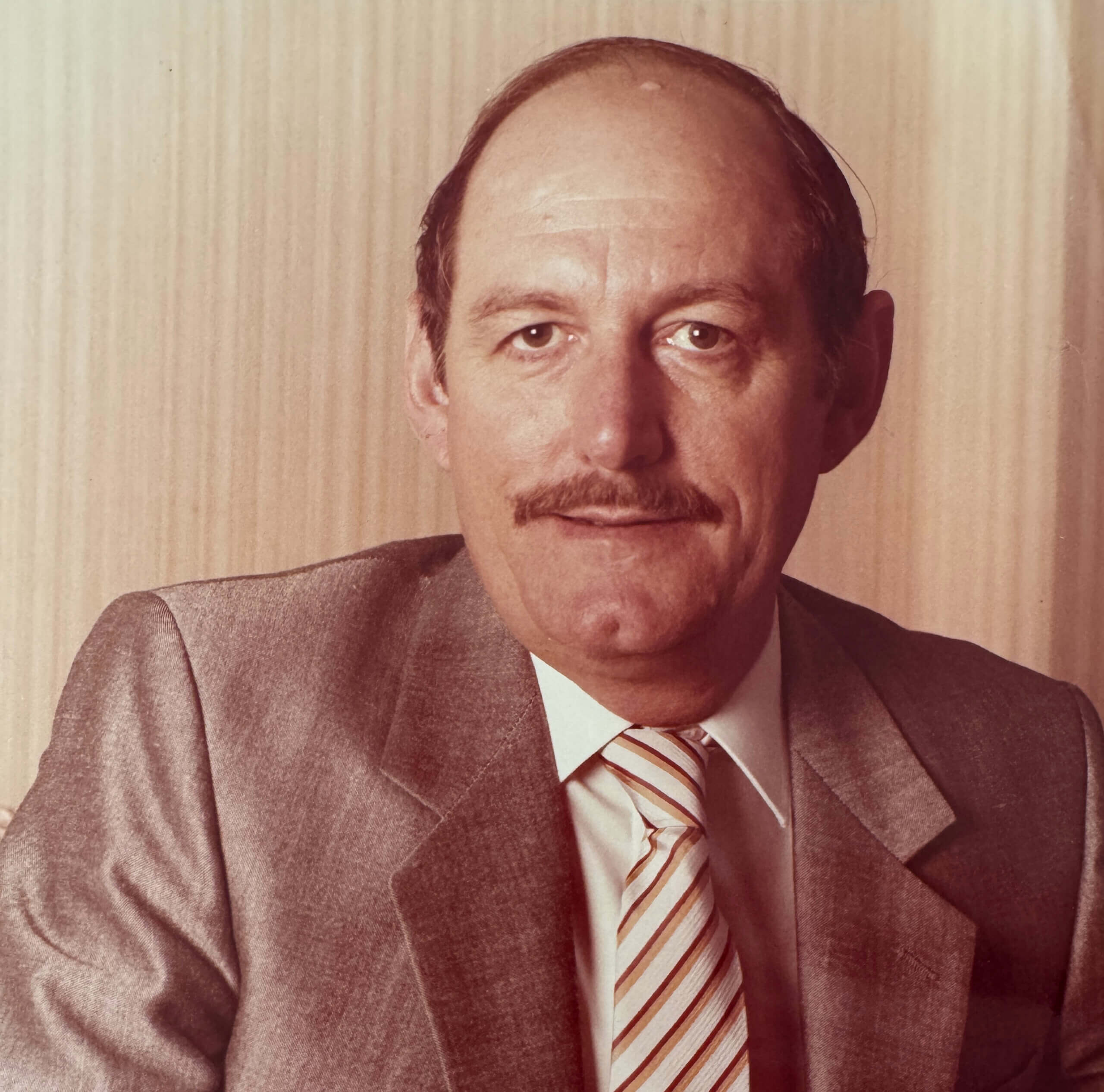
George Chapman
George Chapman
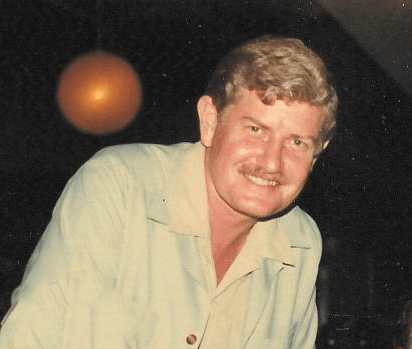
Bill Cummings
Bill Cummings
1970s FNQDB VIC 1 Lake St, former Cairns Harbour Board office
1970s FNQDB VIC 1 Lake St, former Cairns Harbour Board office