1990 – 1999
Disaster Builds Resilience
Monk left to become North Queensland Director of Marketing for Daikyo whose developments, including the Cairns International, Matson Plaza, Paradise Palms Golf Course, Forest Gardens, the Village Arcade and Yamagen restaurant, were shaping the tourism infrastructure of Cairns in the 1990s. Green Island Resort had closed in 1989, and two years later in 1991, Daikyo purchased both it and Great Adventures from Dreamworld Corporation, announcing plans to rebuild the resort.
In 1988, Bureau Board member Geoff Donaghy was part of the selection committee seeking a new GM to replace Monk and the Board soon realised they couldn’t attract the right person to take the organisation forward. As the Sales and Marketing director of the Ramada Resort at Palm Cove, Donaghy was part of the first internationally operated organisation to come to town, and he understood the need to sell the destination first.
“You need to make sure the cake grows, and everyone takes their slice,” Donaghy said of destination marketing. “There was a great sense of comradery in the region, but it needed to be formalised to work for the destination. I thought about this and the other opportunities the Bureau had and approached the Chairman Don Lister to say I was thinking about putting my hand up. He wanted it done properly so I stepped aside to go through the selection process alongside the other candidates.”
Taking on the role in January 1989 when the tourism industry was booming, Donaghy was eager to accelerate international marketing, but his plans were disrupted when pilots walked off the job following a busy winter season. The dispute dragged on through summer into 1990, effectively cutting off the flow of visitors to Cairns.
Tourism was worth $400 million to the region and suddenly there were no customers. Donaghy met Prime Minister Bob Hawke in his suite at the Pacific International Hotel alongside Federal Member for Leichhardt John Gayler to discuss how reliant Cairns was on tourism and how its economic benefits filtered down throughout the entire community. “We moved into survival mode for a while, watching businesses go broke and friends lose their jobs. It was a very sad time. But from chaos comes opportunity. There are two things you can be sure of in a crisis – they finish, and you don’t know when, so you have to be ready. We needed to get ahead of it and make the place more professional,” he said.
The first opportunity was to demonstrate just how dependent the region was on tourism as an economic driver and on aviation to deliver visitors. The Bureau developed case studies to demonstrate how pharmacies, dry cleaners and even day care centres benefitted from tourism and how those dollars dried up when jobs disappeared. Donaghy, a former school teacher, even did school visits to increase awareness. “On the Tablelands, I took out a dollar and said the tourist brings this into town. They use it to stay at a hotel and buy dinner made with food grown on the Tablelands, which goes to your parents and ends up as your pocket money.”
The next opportunity was to get locals to become tourists. “We organised a mini trade show at the Showgrounds talking to the local community to get business trickling through to operators. It created comradery with the operators wanting to get the destination first and centre. We realised it was time for the Bureau to lead the region’s operators on international sales missions, instead of just joining QTTC promotions.”
With the Board’s support, Donaghy began leading dedicated Bureau trade missions, moving beyond simply participating in QTTC promotions. “It worked because Cairns was made up almost exclusively of owner operators,” Donaghy said. “They enjoyed working together and there was a lot of passing of leads to each other at trade shows. The region’s operators became well known and other destinations used to say, ‘you guys hunt as a pack’ and it stuck. We started doing missions in our own right in Japan and copped criticism from the Federal Tourism Minister, but the operators wanted to grab their destiny in their own hands.”
Stage 2 of the airport redevelopment was completed in 1990 allowing the landing of 747s with a separate international terminal to welcome visitors and by November 1991 there were more than 140 international aircraft movements each week at Cairns Airport with regular scheduled services from Qantas, Air New Zealand, Solomon Airlines, Air Niugini, Japan Airlines and Garuda Indonesia. In April 1992, Cairns became a major hub for Qantas with daily flights from Honolulu, continuation of the daily flights from Tokyo plus six a week from Ngoya and two from Fukuoka.
In his 1991 annual report, Donaghy wrote that the Bureau’s strategy was to participate in the greatest possible number of promotional activities in Australia and overseas that resources permitted to recover from the downturn brought on by the Pilots’ Dispute. “The Bureau is now acknowledged as one of the most active, aggressive and effective tourism promotional bodies in the country and with the advent of domestic airline deregulation price initiatives and the continuing growth of our international markets, the region is now experiencing the strongest growth and recovery of any destination in Australia.”
In the aftermath of the Dispute, Cairns Rent a Car owner John Vickary, whose business was decimated by the Pilot’s Dispute, was elected Chairman in 1991-1992. Around this time Donaghy, who had been conscious that the Far North did not have a good ring as a destination brand, changed the marketing name on the Bureau’s brochures to Cairns and the Tropical North. It was not popular with places like Port Douglas and Palm Cove as they felt excluded, however, it resonated at trade shows.
It was also time to act on another opportunity that Donaghy had identified even before the dispute – attracting conventions to help build a visitor industry, as other successful cities had done. “A visitor industry is much broader than a tourism industry and a purpose-built convention centre is an integral part of that.” With the five-year exclusion period for a casino to be built in the north ending, the Bureau lobbied Member for Cairns and Treasurer Keith De Lacy for the winning casino tender bid to include funding to develop a convention centre. Bob Manning, who was Cairns Port Authority CEO at the time, said having a treasurer in Cairns helped tourism to progress with the convention centre the next thing after the airport to help grow the industry.
The Bureau and Port Authority lobbied for the former gas tanks site to be the centre’s location as it offered the opportunity for future expansion. In January 1992 the Queensland Government called for submissions to build and operate a casino in Cairns and construction started on the Cairns Convention Centre. This activity started during a downturn for FNQ tourism which lasted until the mid-90s. The destination’s share of international visitors declined to the lowest in six years at 16.5% in 1995 and the yield from accommodation had remained the same for the past six years.
A small company in Brisbane, International Facilities Corporation which later merged with Ogden to eventually become AEG Ogden, was awarded the operation rights to the Cairns Convention Centre and its Director, Harvey Lister, approached Donaghy to head up sales. However, Donaghy wanted a greater challenge and said he wanted to be GM, leaving FNQPB during 1994 to set up the first purpose-built convention centre outside a capital city and develop the business events industry for the Far North.
“As a leisure destination, Cairns had a strong image of tropical holidays and resorts, so we used that to develop the tagline ‘Serious business in Australia’s most stunning location’ and developed a reputation as the place with the highest proportion of delegates who brought their spouses for a holiday. The Cairns Convention Centre was instrumental in increasing visitation in the shoulder seasons and the growing business events industry was a critical part of business for the international hotels, just as brands like the Hilton and Holiday Inn were instrumental in helping drive that business events growth.” The Centre went on to be named the World’s Best Congress Centre in 2004 and 2014.
In addition to the economic value the Convention Centre brought to the community it also helped the city to win the licence for their first national sporting team, the Taipans NBL team. This win in turn allowed the Centre to expand to accommodate home games.
Donaghy went on to become CEO of Suncorp Stadium overseeing its redevelopment and later the CEO of the International Convention Centre Sydney. He also served as the President of the International Association of Congress Centres and Chair of the Business Events Council.
Mike Burgess from Quicksilver had been appointed Chairman in 1993 and with the support of Cairns Mayor Kevin Byrne and Port Authority CEO Bob Manning, Burgess led a major change to the Board’s structure, removing the requirement for geographical representation. This allowed more tourism representatives, rather than local government directors, to take leadership roles. Burgess said Board meetings were more like a council meeting and councillors were only interested in their area.
“Most of the funding was coming from the Port Authority, Cairns City Council and Mulgrave Shire Council with very little from the tourism sector. Cairns Mayor Kevin Byrne and Bob Manning backed me, but Mulgrave Shire Chairman Tom Pyne was not happy and threatened to withdraw his funding. However, it was time for our organisation to stand on its own two feet. Tom backed down and we started to get tourism people on the Board including Stephen Gregg from QTTC, while Bob Manning came on as my deputy for two years. Bob was a great supporter of the FNQPB. We had the funding and were able to spend it the way the organisation believed it needed to be spent. Within a year, FNQPB had the largest membership of any tourism organisation in Australia, and we were starting to hit some home runs in the way we were doing marketing,” he said.
“Another personal challenge was to get Cairns on the TV weather maps which just showed capital cities. John Morris was a major advocate, and we pushed the TV stations telling them that most tourists were going to Cairns and wanted to know what was happening with the weather.”
The next GM was Steve Noakes who joined in 1994 and had also served on the FNQPB Board alongside tourism identities including Don Freeman from Tjapukai and Savannah Guides founder John Courtenay. Noakes first visited Cairns in 1979 as a tour guide working for Centralian Staff Holidays and returned to run the Adventure Centre selling travel into Papua New Guinea and then the Solomon Islands with his wife Suzanne.
In 1995 the FNQPB entered the digital age after Steve attended a PATA conference in Auckland where he heard about the way people were going to communicate with the World Wide Web. At that time, the Bureau had a couple of desktop computers and Steve’s PA Katrina Wright (now Edmondson and the owner of Sailaway Port Douglas with her husband John) used to print out emails so Steve could write responses for her to retype and send. He introduced laptops and computer training for staff and provided training for the industry.
The FNQPB then introduced the Aussie Host customer service training, becoming the first RTO to employ a dedicated customer service training manager with Rosie Douglas taking on the role from 1994 to 1996 and Suzanne Noakes one of the first dedicated trainers covering the whole region. After boosting the membership numbers and income to expand marketing activities, Steve wanted international marketing expertise on the team and convinced Megan Bell, who was running the QTTC’s LA office, to join in 1995 as marketing manager.
What’s In a Name
By the mid 1990s, Noakes and the Board decided it was time to rebrand the destination to better reflect its identity and potential. Manning, who was elected Chairman in 1996, strongly supported the move, concerned that wholesalers and airlines were shaping a version of Far North Queensland that suited their sales strategies, not the region’s unique offering. There was no existing blueprint for a regional destination to reposition itself, but armed with a $50,000 grant, the Bureau partnered with Tourism Queensland (TQ) and the ATC on what became the Brand FNQ Report. It was the first time three levels of Australia’s tourism organisations collaborated on a joint marketing initiative.
Many, including Noakes, were keen for the Great Barrier Reef to be part of the core destination name. “ATC CEO John Hutchinson, who I knew through our involvement with PATA, had steered the new Australian brand approach promoting big nature experiences as a competitive advantage,” Noakes said.
“Cairns delivered on this promise with the Reef and the outback, but we had to go through a strategic process to fully understand the market performance to date, the current situation and where we wanted to go in the future. With the support of ATC Chairman Don Morris and John Morris of Port Douglas, we were able to harness the necessary skills, networks and resources to undertake the ground-breaking destination research.
“The Great Barrier Reef was a key experience and my thinking at a national level was how Cairns could take ownership of Great Barrier Reef experiences to become Australia’s dominant gateway to the Reef. The research showed the Great Barrier Reef branding was very strong for Cairns. We had good support from ATC, but not from TQ who said they could not support one coastal Queensland destination taking ownership of the Reef. It shows how politics plays a role in destination marketing when you need the marketing funding of the State Government’s tourism authority.”
Tourism in the region was evolving and diversifying, with Australia’s first bungy jump, the growth of white water rafting and new owners at Paronella Park and was set for an upward trajectory with the opening of The Reef Hotel Casino on 31 January 1996. Monk had joined their marketing team to create the city’s most extravagant opening event. Abbott St was closed for one week to erect a marquis for 500 tourism identities including wholesalers and ITOs to be treated to a spectacular evening of dining and entertainment by Dame Edna Everage and jazz musician James Morrison.
Business Events Emerge
With the Cairns Convention Centre opening on 26 June 1996, Liz Bindon-Bonnie was appointed the first dedicated convention specialist for the organisation bringing experience from Perth and a new skillset to attract conventions to the city. “The organisation and the destination had such a good reputation that we were able to attract good people to TTNQ,” Noakes said. It also brought new opportunities to develop businesses to support the fledgling business events industry with Donna and Peter Anderson founding NQ Exhibitions.
Indigenous tourism had also become important to the destination with Tjapukai Aboriginal Cultural Park becoming Australia’s largest private employer of Indigenous people when it opened at Smithfield on July 8, 1996 with 116 of its 138 staff Indigenous. The Tjapukai dancers were ambassadors for Indigenous culture and the destination having performed at Expo 88, were part of the ATC’s World Tour in 1990, and performed at the Commonwealth Games in Canada in 1994, the same year they performed for the Queen.
In November 1996, the findings from the Brand FNQ Report were delivered. One of the most significant insights was that the name Far North Queensland was working against the region in domestic markets, reinforcing a perception that the destination was remote and difficult to access. The report recommended a rebrand to Tropical North Queensland. For international marketing, the suggested tag line was ‘Australia’s Great Barrier Reef’, while domestic audiences were targeted with ‘Where Rainforest Meets the Reef”. In 1998, the organisation officially adopted its new name Tourism Tropical North Queensland (TTNQ), cementing its refreshed identity and vision for growth.
A Cultural Shift
Noakes and Manning both announced their departure at the 1997 AGM, with Cairns Hilton GM John Ingram elected before being transferred in 1999. Limousine operator Peter Goulding, who had worked with the ATC, served from 1999 to 2001, bringing international experience to the Board for the first time. TTNQ Director Cam Charlton, who headed up the finance committee and served as Chair from 2001 to 2005, said the organisation went through a significant cultural change. “We are a membership organisation, but our role is not to service members, it is to grow the destination for the benefit of all members. We decided to double the salary and move from a general manager to a chief executive officer role to attract a different skillset and make a quantum leap forward with the results we were trying to achieve.”
Ian Kean had returned to Brisbane after five years as CEO of the New Zealand Tourism Board when TQ CEO Stephen Gregg, who later chaired TTNQ, reached out. TTNQ’s general manager had just left, and the organisation was in trouble.
The Asian Financial Crisis was also starting to bite with international visitor arrivals down 10.7% in January 1998, largely due to a 33% fall in Japanese arrivals to 11,165 for the month. The Japanese market had become TNQ’s largest international market in 1996-1997 with 240,000 visitors but had started to decline and during 1998 Japan Airlines cancelled direct services from Kansai to Cairns and Qantas cancelled its Sapporo and Fukuoka services to Cairns.
Gregg asked Kean to travel to Cairns to meet with the Board. Reluctant at first, Kean finally accepted the challenge to take over from Noakes in mid-1998. “I like fixing things that are broken or starting something new,” Kean said.
“TTNQ needed rebuilding, so I brought in new managers and staff including Leigh Sorensen as Marketing Manager. Bindon-Bonney was already in situ as the Convention Manager with good experience to grow this business,” Kean explained. “TTNQ formed a new operation, the Cairns and Region Convention Bureau with her in charge and actively sought national and international conventions and incentive group business, working with the team from the Convention Centre, and becoming a full member of the Australian Association of Convention Bureaux.”
Around this time TTNQ was asked to vacate their office in the Port Authority building. Kean contacted Cairns Mayor Tom Pyne who was very supportive and suggested the recently vacated Mulgrave Shire building as its new home. With backing from Cairns Regional Council, TTNQ moved into the facility, furnished with spare desks and chairs free of charge, and made minor alterations to allow the Visitor Information Centre to operate from the front section of the building.
Kean also pushed for TTNQ to be a seller at ATE after regional tourism organisations had been excluded from participating. Tropical North Queensland’s strong international visitation was unusual for an Australian tourism region, with Cairns attracting more international holidaymakers than any state or territory, apart from Queensland and New South Wales. Kean bought this to the attention of the ATC to successfully argue for TTNQ’s inclusion.
However, his key challenge was the declining Japanese market dominated by wholesalers selling four-day itineraries including two or more destinations connected by domestic flights. Visitors were worn out by Japanese companies ferrying them around on tours from dawn to dark and TTNQ thought they would prefer four days or more in one place for a holiday break.
Well connected with senior figures in Japan’s travel industry, Kean understood meaningful negotiations needed to happen between decision-makers. He travelled to Japan every four months from the end of 1998 to meet with the presidents and vice-presidents of major wholesalers, pitching the idea of Cairns mono destination holidays. These were four to five-night packages where travellers would fly into Cairns, unpack, have a holiday and then fly home. The strategy worked with one major wholesaler, HIS, selling more than half their total Australian business as Cairns mono holidays.
By the end of the 1990s tourism was worth $1.2 billion a year, however, the TTNQ budget was very limited, coming from membership fees, and contributions from TQ, Cairns City Council and the Port Authority. While the Port Authority increased their contributions each year, the remainder of the budget was static. Ian approached Austrade regarding TTNQ being eligible for the Export Market Development Grant (EMDG). No State Tourism Organisation or Regional Tourism Organisation (RTO) was participating in this scheme, but Ian convinced the Austrade official that TTNQ did indeed qualify. This grant, linked to TTNQ’s direct marketing spend, was a welcome shot in the arm financially. However, other RTOs then bombarded Austrade to also be eligible and not wanting to pick winners, Austrade cut TTNQ off after three years. Still, around $500,000 was put aside in a special ‘building fund’ with the idea of being able to purchase premises in the future and not have to pay rent.
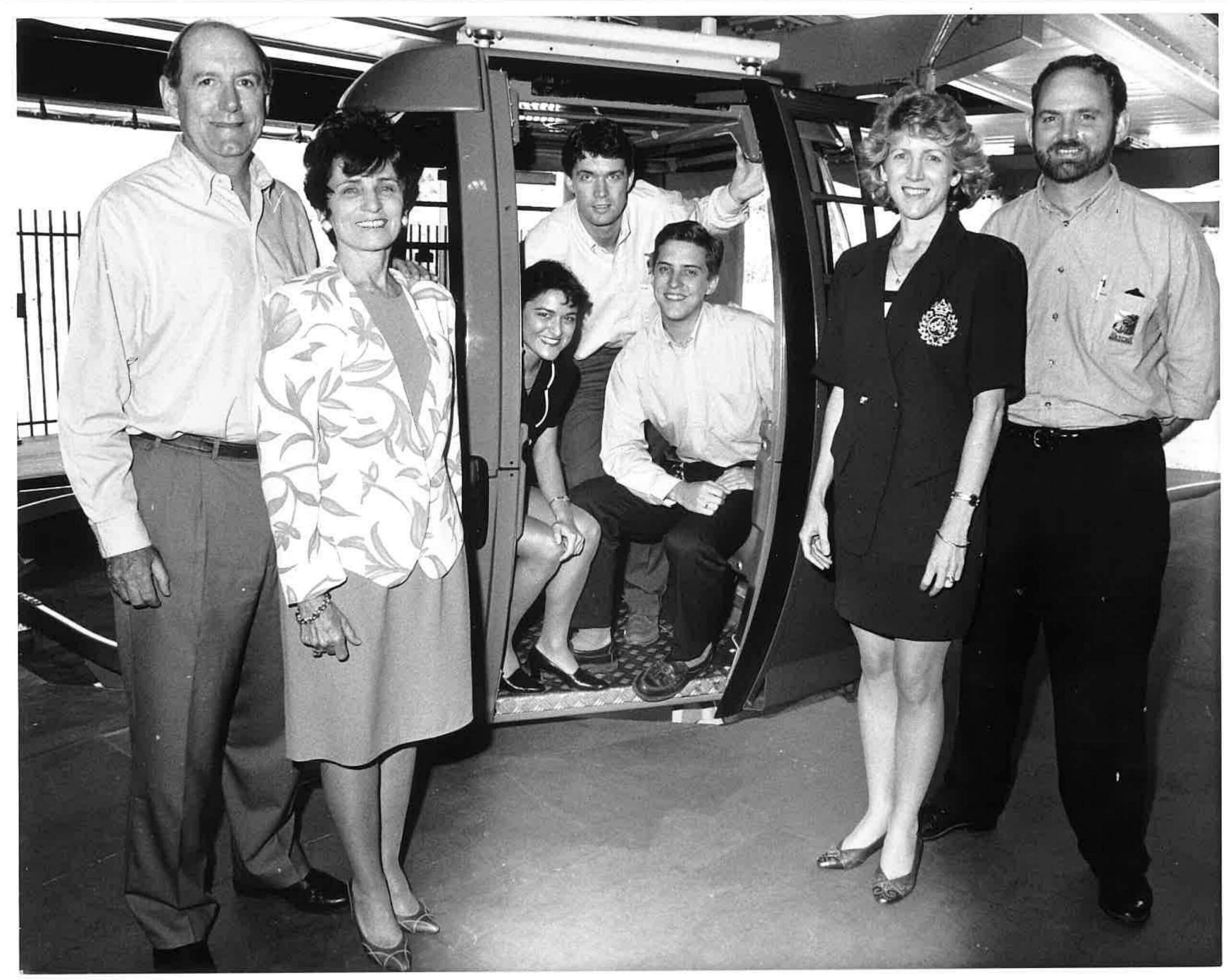
George, Margo, Karen and Ken Chapman Skyrail opening
George, Margo, Karen and Ken Chapman Skyrail opening
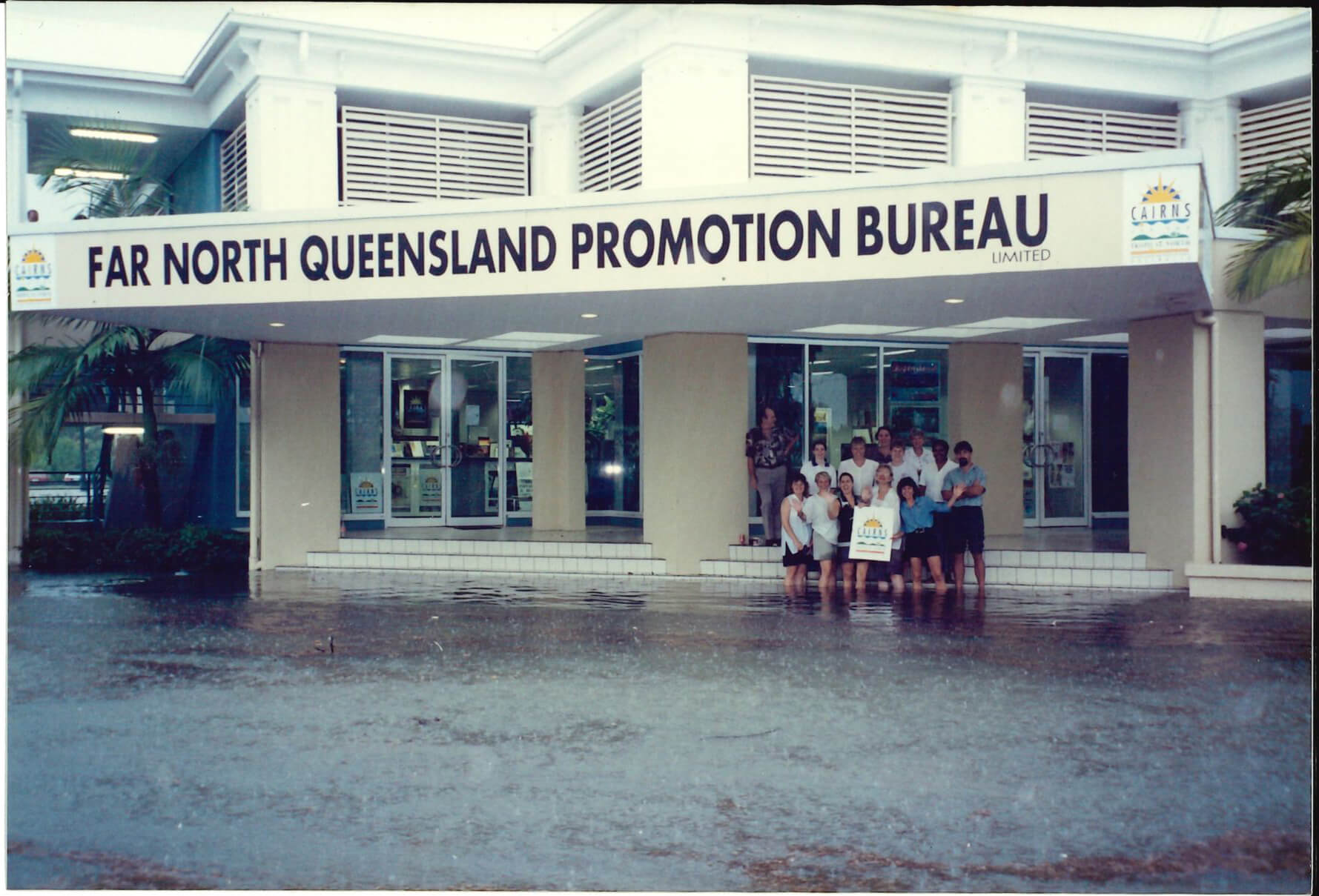
FNQPB - Port Authority Building
FNQPB - Port Authority Building
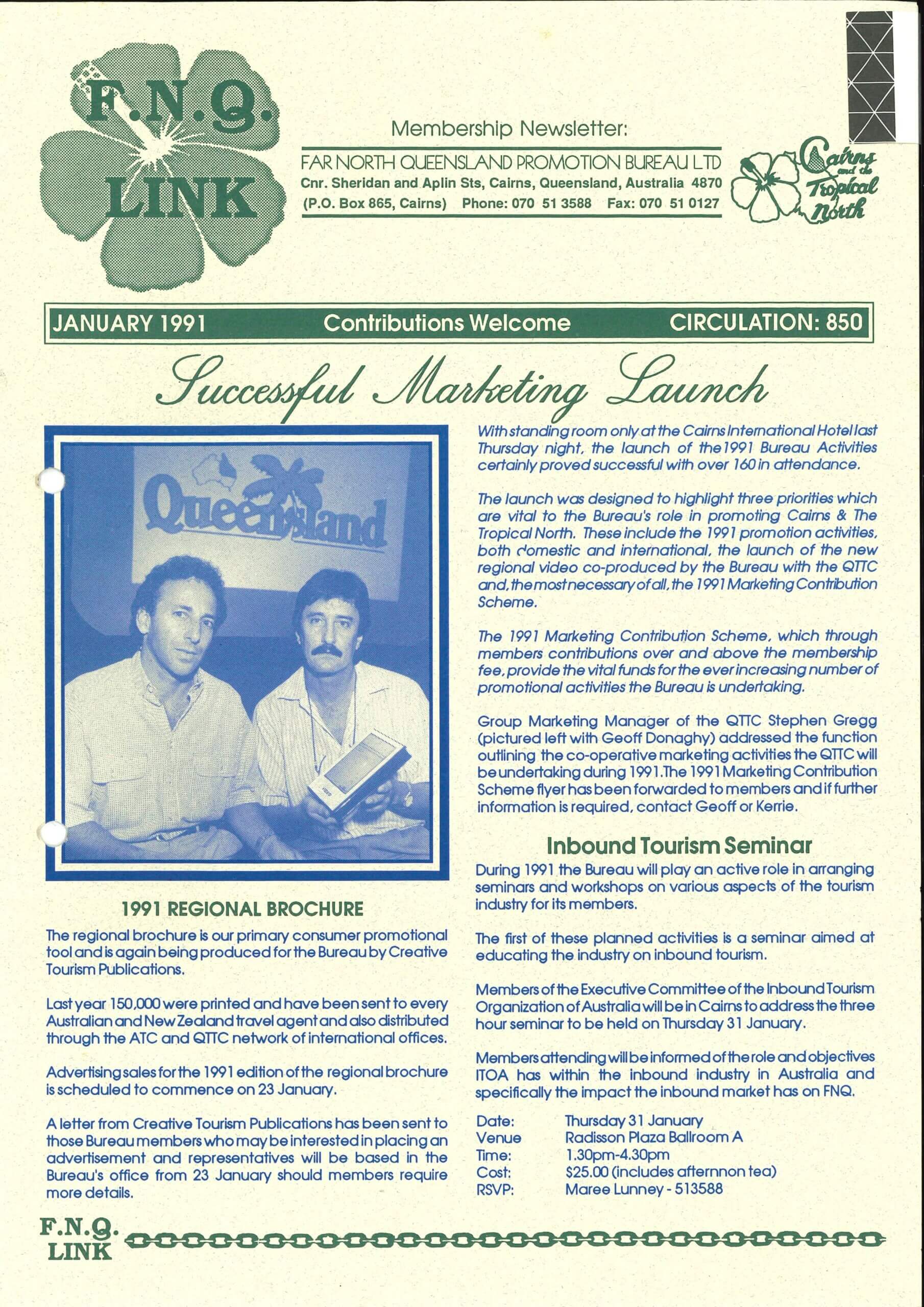
Stephen Gregg & Geoff Donaghy 1991
Stephen Gregg & Geoff Donaghy 1991
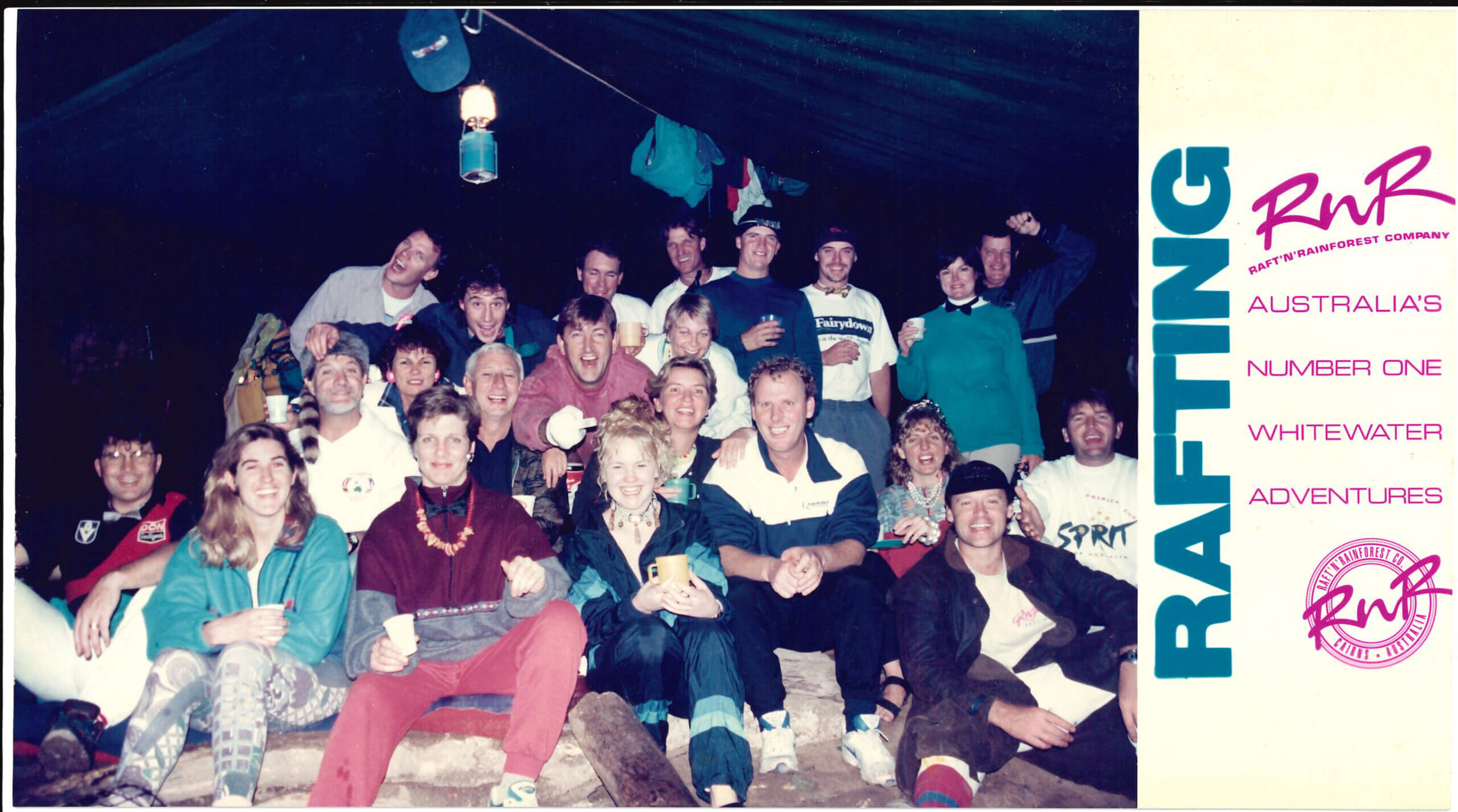
South Johnstone Rafting trade trip mid 90s
South Johnstone Rafting trade trip mid 90s