1980 – 1989
Going International
Work to develop the Japanese market increased in the early 1980s with the Bureau developing promotional brochures in Japanese, hosting a television crew and other media from Japan, and Cummings joining the Queensland Government Tourist Bureau’s first tourism mission to Japan in 1981. A branch of the Australia Japan Society was formed at a meeting organised by the Bureau with Bureau Deputy Chairman Peter Cominos elected as first President. While Air Niugini subsequently ceased flying to Japan, the industry’s experience laid the foundation for eventual success in developing Japan as the first major non-English speaking market when direct flights were subsequently developed.
With the early contact with the Japanese market, Cummings said there was recognition that different names and images were required for marketing internationally. Tropical Wonderland had been appropriate for the Australian market in the 1960s and early 1970s, and the Far North portrayed an exotic different image for Australians that differentiated the area from Townsville North Queensland. However, the term Far North for the Japanese meant the Arctic and extreme cold.
Cummings asked Ken Onishi, the tour guide accompanying many of the Japanese groups, what front cover brochure image would appeal to his guests. “He startled me by saying, ‘a blonde child and a kangaroo’. The television series Skippy featured blonde children, a kangaroo and an Aboriginal lad, and was all the rage in Japan at the time. However, it prompted us to think deeply about the question of names and images, and I concluded that there were three broad areas of markets for which the area had a different appeal,” Cummings said.
“The first was the major Southern Australia market, that also included New Zealand for which the appeal was ‘the tropical difference’ of the Reef and the rainforest but also winter warmth. The second was the nearby markets of Tropical Australia and the Papua New Guinea/Pacific where Cairns represented a close, relatively well-developed holiday break destination with nice hotels, shopping and activities. In this market, it competed with the Gold Coast. Third was the distant Overseas Markets where the further you went from Australia, the more the global icon of the Great Barrier Reef became important as the key attraction and the more Australia’s difference became important.”
With the Japanese market well established, Cairns’ case for an airport upgrade was further strengthened after a discussion between Chapman and a US airline executive, who recommended commissioning a report on the region’s potential for international tourism from the San Francisco-based Pacific Asia Travel Association (PATA). Acting on this advice, Cummings flew to Papua New Guinea, where PATA representatives were conducting a study, and asked for their assistance. Soon after, PATA tourism experts from the United States, Japan and New Zealand, along with an Australian contingent comprising representatives from Ansett, TAA, ATC, Queensland Tourist and Travel Corporation (QTTC) and National Parks visited the region and in early 1981 they reported favourably on the destination’s potential.
The push for an international airport had hit full throttle, but debate raged in the community over the local ownership proposal with The Cairns Post Editor Alan Hudson writing “this has split the town as we have never seen it split before”. The major concern for the Cairns community was the proposal for Council to lead the airport ownership. The debate was quelled when it was announced the Cairns Harbour Board would take over negotiations from Council. The Cairns Airport Bill was passed in State Parliament and on 14 December 1981 the Board, which had by then become the Cairns Port Authority, officially assumed control.
Chapman later wrote that the airport upgrade was as critical to the community’s future, as the original development of the railways in the late 1800s. “I’m convinced that this is the single most important project in Cairns in the second half of the 20th century, and I don’t say that lightly,” he said. “The success or failure of this airport will decide whether Cairns is a satellite city in the Townsville region or whether Cairns continues to grow and prosper as a vibrant economic centre of a region on its own.”
In 1981 the Cairns region was second only to the Gold Coast for international tourism visitation and had one of the highest population growth rates in Australia. In the Annual Report that year, Chapman wrote that the Bureau was highly regarded in the tourist industry and government circles because their submissions were well researched and responsible and they were prepared to confront the authorities if they thought the region was being treated unfairly. “I am convinced that the Bureau has played a large part in this achievement. It is not just coincidence that this growth and recognition has happened since the Bureau formed,” he wrote. He said the Bureau also had a role to play in ensuring development did not detract from the natural beauty that attracted people to the area.
Around the same time, the Bureau was forced to relocate its offices and information centre from the old Fire Brigade building to temporary premises in Abbott Street to make way for a Council parking station. Both Chapman and Cummings departed in September 1981. Journalist Alec Martin was appointed General Manager (serving until 1984), and Carlton & United Breweries Manager Chris Johnson became Chairman in 1982 and 1983 before leaving Cairns and handing over the reins to his deputy, Ron Berry, then Douglas Shire Deputy Chairman.
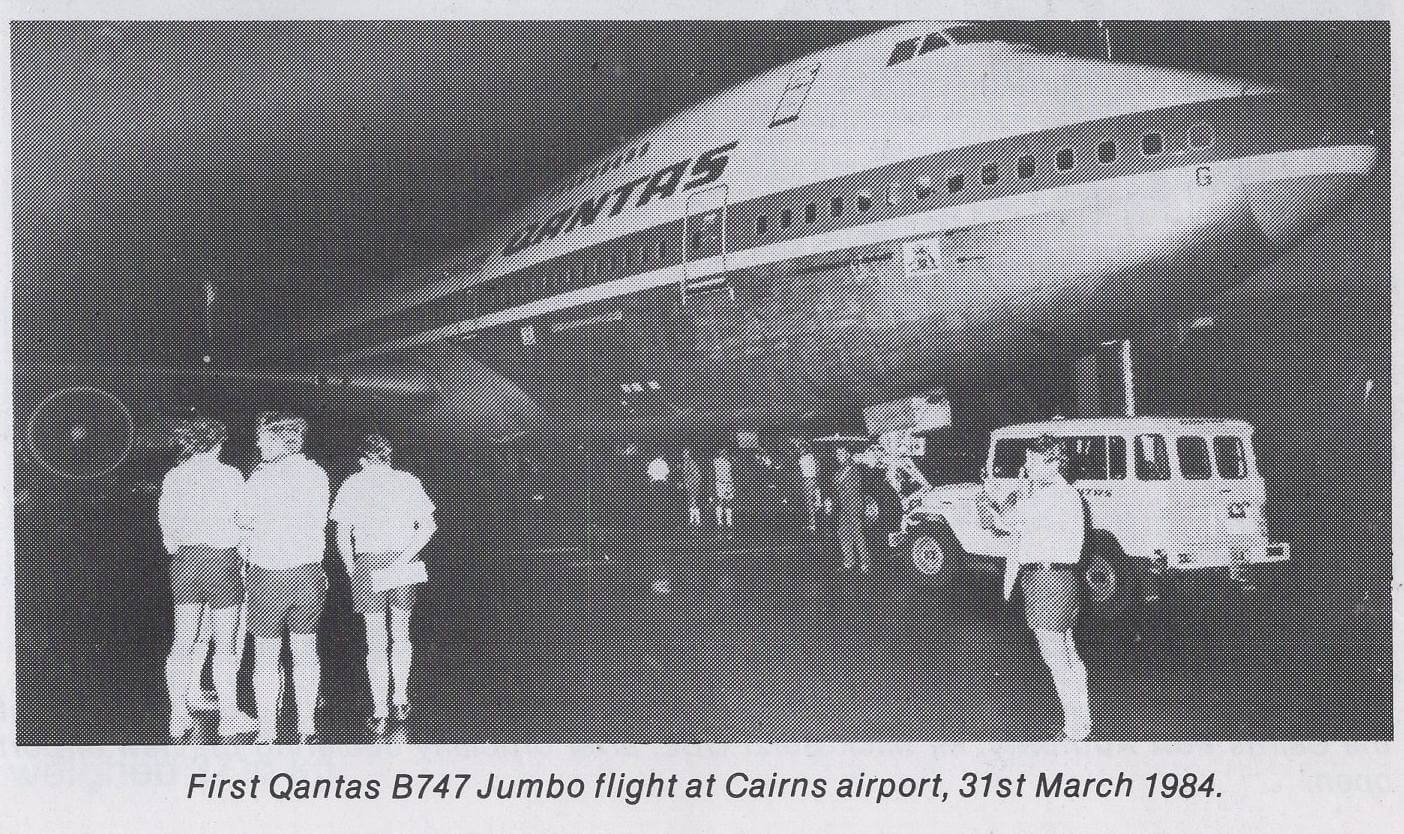
The $35 million redevelopment of Cairns Airport was scheduled to open on 31 March 1984 with the week of 17 March to 3 April 1984 dedicated to opening events. The timing could not be better as Tourism Australia’s Shrimp on the Barbie advertisement with Paul Hogan had resonated with American audiences the year before. Qantas announced discounted airfares between North America and Cairns, while local tour operators offered 30-50% discounts on accommodation, reef trips and bus tours.
The Bureau printed a brochure promoting the many public events and an Airport Shop opened in Shields St selling mementos, T-shirts, dresses and hats commemorating the opening. The Inbound Tour Operators of Australia held a three-day seminar at the Pacific International Hotel so the important ITOs could join the festivities and dignitaries were invited. The Bureau was the first organisation outside a State or Federal body to organise an ITO workshop in Cairns.
Ticketed events in the leadup to the weekend included the National Businesswoman of the Year speaking at a business lunch, the Australian Mannequin of the Year modelling at a parade by the combined fashion houses of Cairns, a world attempt at a conga line, and a concert with Dame Edna Everage, Barry Crocker and Julie Anthony.
Saturday was people’s day at the airport with free entry to see an air race, an aircraft display, world record parachute jump attempt and flying display ahead of QF25 taking off at 9.40pm for Honolulu. An International Airport Ball was held in the Aero Club Hangar, the Governor’s Ball was at the Playpen, and a Country Music Spectacular with acts including Red Gum was at the Showgrounds.
A mass parachute jump onto Green Island was held on Sunday to take the Airport to the Reef, followed by a rock concert at the Showgrounds with Rose Tattoo, the Radiators and the Sunny Boys. Cairns City Council held a Civic Reception on Tuesday for the 6.40am arrival of the first inbound flight, Qantas QF26 from Honolulu.
Martin’s report to the Board in November 1984 detailed a review of direction for the Bureau to capitalise the potential of the international airport. It recommended concentrating on the North American market, and participation in QTTC’s New Zealand promotion with the hope that the introduction of B767s to Qantas could lead to direct flights.
Europe, Southeast Asia and Japan were thought best to be left until the development of direct air services. However, it recommended planning begin to participate in ITB Berlin in 1986-87, despite only State, Federal and private tourism organisations being invited through the ATC to attend the billion-dollar marketplace for senior and well-established holiday packages.
The proposal said it was essential that the Reef must first feature to sell Cairns, and Cairns must then sell the rest of the region as people overseas knew of the Great Barrier Reef, but hardly any had heard of Cairns, let alone any of the regional destinations such as Port Douglas and the Atherton Tablelands.
The tourism industry was coming of age and looking to the future. The Cairns Tourism and Hospitality Industry Training Committee was managing industry training as recommended by the PATA report. It also recommended setting up a special task force with State Government support to develop the cultural product the region had to offer.
Contra Doesn’t Pay Bills
General Manager Larry Monk arrived in 1985 after a career that included tourism and economic development with local government on the Central Coast and a role as a NSW tourism commissioner. What he didn’t realise when applying for the job was that the organisation was in substantial debt due to huge cost blow outs with the Cairns International Airport opening promotions.
“During my interview they asked me to leave the room after I asked about the budget. I was told what the budget was – just not that it was in the colour red. A friend working at ATC asked why I accepted the job, saying ‘don’t you realise they are broke’. I rang Ron Berry, the Chairman at the time, to ask what was going on and he sent clips of The Cairns Post in the mail – it was the first I heard of their financial difficulties,” Monk said.
It didn’t deter him. “I was excited about where Cairns was going with new development such as the airport. Once I got there, I thoroughly enjoyed my time, but there were harrowing moments. The financials were the most harrowing. When everyone knows about the financial woes it is hard to get people back onside and build up membership. Our biggest concern was funding, but once we had the confidence of the industry, the membership took care of itself.”
Far North Queensland Electricity Board General Manager Don Lister became Chairman in 1986 and provided a stabilising influence on the Board. He supported Monk’s efforts to restructure the organisation and return it to financial health. The first step was expanding the membership base using a proposal developed after conversations with Quicksilver’s Jim Wallace and Max Shepherd, Charlie Woodward, John Morris and Monk, to include all businesses that directly or indirectly benefitted from tourism.
“The Bureau wanted to increase the annual income of $250,000 by $500,000 through new membership levels including special recognition, gold, silver and bronze to include everyone in the industry. Previously members paid whatever they wanted to give and there was a lot of contra but no cash. Unfortunately, contra doesn’t pay the bills,” Monk said.
As industry optimism surged, so did membership. “It seemed like a new hotel opened every six weeks. They were very exciting times with fantastic job growth. We had an exciting destination with new infrastructure and great natural assets that appealed to inbound tour operators and wholesalers now that we had international access,” Monk reflected. At the time, six major tourism projects worth a combined $325 million were under construction including Trinity Wharf, Hilton, Sheraton Port Douglas, Park Royal, The Pier and Port Douglas Marina. The hotels would add another 1050 rooms to the destination bringing the total room stock to 3699.
This development was tied into several economic factors including former Treasurer Paul Keating’s 1986 warning that Australia would become a Banana Republic and the floating of the declining Australian dollar. Domestic tourism surged as Cairns was seen as an exotic international destination by people in Sydney and Melbourne who were deferring overseas travel with the poor exchange rate. The deregulation of Australia’s banks meant they were scrambling for market share and happily lending money for development.
The drop in the dollar after 1986 and the oversupply of high-standard new hotel rooms made Cairns super competitive and very attractive to the Japanese market. In April 1986 the first direct flights to Japan started with capacity doubling in November 1988 when two 767 aircraft each week were replaced by 747s. These were Qantas aircraft with half the seats allocated to JAL. In 1981, there were 1490 Japanese were arriving in Cairns, which was a market share of 3.1%. This figure declined and then started to lift with the introduction of direct flights building to 45,600 visitors and 13.6% market share in 1989.
Showcasing the growing destination was critical to the success of these investments. The Bureau’s small team of five included two staff dedicated full-time to hosting famils for visiting trade and media, which was often on a shoestring. “The industry came to the party, and nobody refused us a bed or a tour to host famils. Charlie Woodward used to say ‘FOC means friends of Charlie’s,” Monk laughed.
Monk credited a core group of committed industry figures with helping to market the destination, including Woodward, Jim and Jo Wallace (Quicksilver), Moss Hunt (Silky Oaks), Peter Miller (Tuna Towers), and Rob Prettejohn (Kewarra Beach Resort). Others included Denis Ferguson from Bush Pilots, who co-founded Destination Management Company with Denis Donaghy in 1986; Graham Gordon, former sales manager for Hayles and later Great Adventures; Jill and Ted Hynes (Inbound North Australia); and Ray Rogers from the former Holiday Inn on Sheridan Street. Many of them travelled together on trade missions.
“They worked together and socialised together and didn’t try to outsmart each other. They were more interested in growing the region and saw a great opportunity to do that. In my position I was very lucky to have them. The Gold Coast was very competitive with each other, which made us stand out.”
Having local airline managers also proved invaluable. “Domestically, we formed an alliance with Ansett which was very helpful as they provided office space, flights for us to do presentations to domestic agents in all capital cities, and they did all the work to get the agents to the sessions,” Monk explained. “Noel Davidson was a very pro-active Cairns manager of Ansett at the time. Qantas Cairns Manager Max Plummer was also supportive and provided heavily discounted or FOC flights. I think we were the only region to get that support from the airlines, particularly in the domestic market.”
In 1987 the industry was worth about $200 million to the regional economy and employed 2000 people. The Bureau had spent $1.7 million in 15 years to build it up from a $20 million industry in the early 1970s. Former GM and economist Bill Cummings
presented a report in May 1987 on the role and funding of the Bureau. It showed Bureau income in the early 1970s was about $100 for every room, but by 1985-86 had fallen to $41. Domestic airport passenger movements had risen four-fold since the early 1970s compared with a 40% rise in the Bureau’s real income. In addition, the Bureau was working globally to support flights to Perth, New Zealand, Europe, Southeast Asia, Japan and North America, compared to the 1970s when market penetration was mostly into Sydney and Melbourne, and a lesser extent to Adelaide and Brisbane.
Tourism was also proving its worth to the local economy with the population growing, new housing developments and shopping centres were coming online and other industries were benefitting, for example NQEA was building the new Quicksilver catamarans which were launched in 1988. Another key piece of tourism infrastructure was also in the pipeline, Skyrail Rainforest Cableway, the region’s first major ecotourism development in a national park. Developed by George Chapman’s family business, the project was seeking approvals when the ancient rainforest surrounding Cairns was declared the Wet Tropics World Heritage Area in 1988.
An Airline Intervention
In 1988, talks were scheduled between Australia and the US to negotiate the next round of aviation rights. The Queensland Tourist and Travel Corporation (QTTC) was advocating for flights into Cairns and Continental Airlines had expressed an interest in operating services from Hawaii to both Brisbane and Cairns. QTTC Chairman Sir Frank Moore, working with the Australian head of Continental, orchestrated a bold and unexpected intervention. According to former QTTC Deputy CEO Ian Kean, they borrowed Christopher Skase’s private jet to fly the entire US negotiating team from Canberra to Cairns for the weekend. Kean flew in separately to meet them.
They stayed at the new Sheraton Mirage at Port Douglas, snorkelled on the Reef with Quicksilver, took a helicopter to Cape Tribulation and played golf before returning to Brisbane to see Expo 88 and then to Canberra. QTTC’s goal was to show the US team, most of whom had never visited North Queensland, exactly what their fellow citizens could enjoy if flights into Cairns were approved. “During the weekend the senior US government official called his boss in the States saying he had better come over as they needed to get the rights into Cairns. He arrived to join the talks and Continental started services into Cairns and Brisbane soon after. Airlines from other countries followed demonstrating the need for direct services into Cairns,” Kean said.
1984-First Qantas B747 SP jumbo flight
1984-First Qantas B747 SP jumbo flight
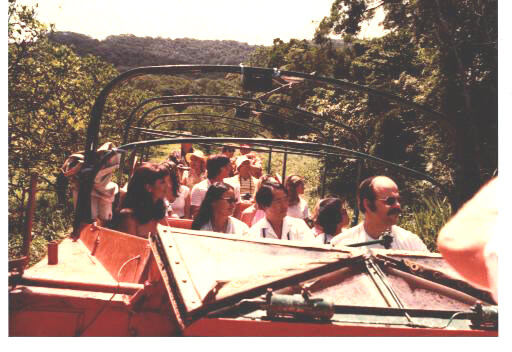
1981-Charlie driving for Aeroguard advertisement
1981-Charlie driving for Aeroguard advertisement
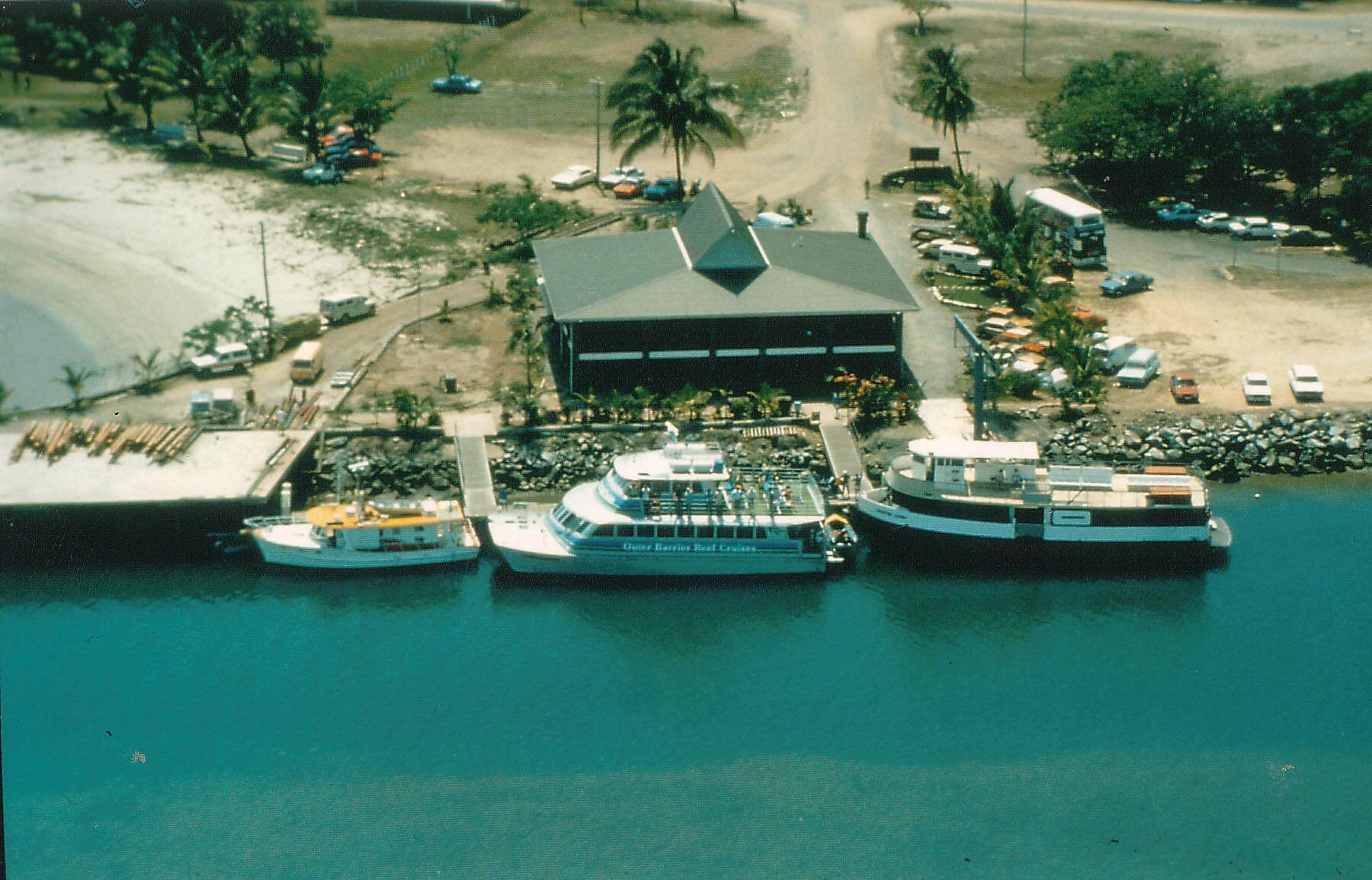
Quicksilver Port Douglas wharf circa 1982
Quicksilver Port Douglas wharf circa 1982
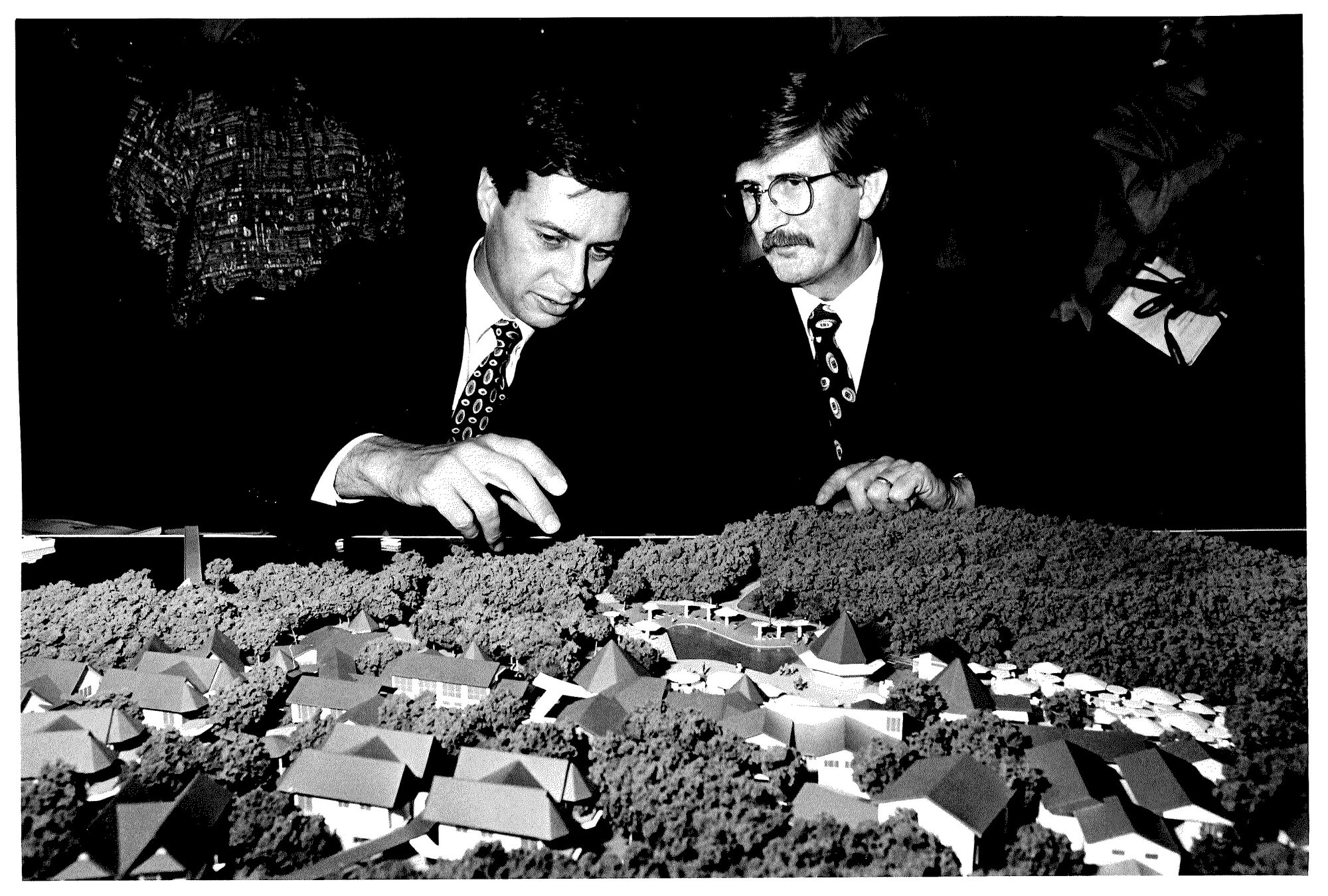
Federal Tourism Minister Michael Lee & Larry Monk Green Island development
Federal Tourism Minister Michael Lee & Larry Monk Green Island development